
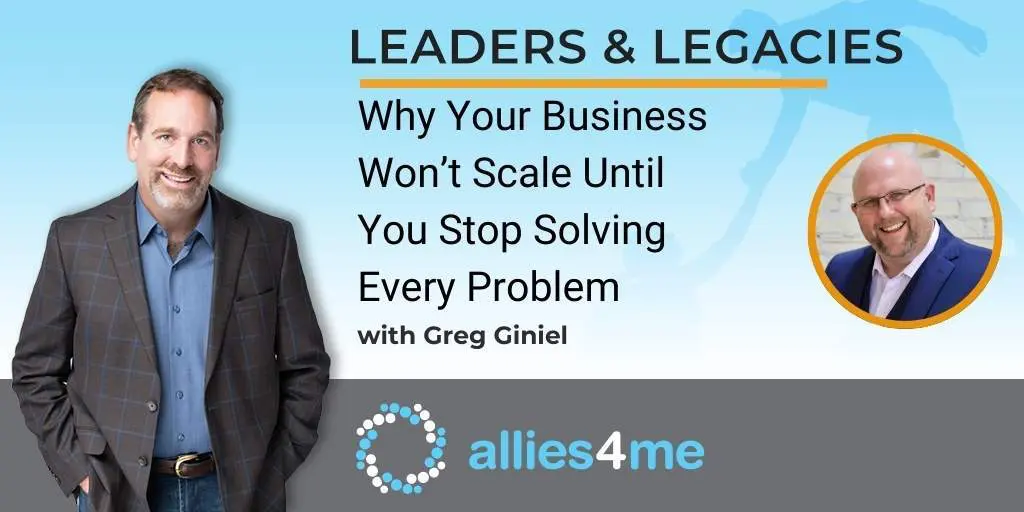
Greg Giniel, a professional EOS (Entrepreneurial Operating System) Implementer, joined Craig Andrews on the Leaders and Legacies podcast to discuss what it really takes to build a business that runs without you. Greg shares how EOS helped him step away for a month during a serious COVID illness and come back to a business that hadn’t just survived, but thrived. The conversation digs into why empowering your team to make decisions (and make mistakes) is more valuable than being the smartest person in the room. Key themes include building a culture of accountability, why a 0% failure tolerance is a leadership trap, and how core values become the operating manual your team uses when you’re not around. If you’ve ever felt like your business can’t function without you in it, this episode is worth your time.
Want free EOS tools? Email Greg at greg.giniel@eosworldwide.com with “free tools” in the subject line.
Transcript
Greg Giniel Hey, Craig, thank you for having me.
Craig Andrews So I had never heard of VOS till probably six or seven years ago. I had no idea what it was. But as I’ve learned, as I started learning about it, it was like, this is something that makes incredible sense.
Greg Giniel Yeah.
Craig Andrews How would you describe it to people?
Greg Giniel For me, it was life-changing. Excuse me. EOS is a business operating system that has time-tested, simple but powerful tools that helps the business owner achieve 3 things, vision, traction, and health. And So vision from the standpoint of getting the leadership team 100% on the same page on where they want to go and how they want to get there, Craig, while kind of instilling discipline and accountability at the leadership team level and really creating a company culture that really is a healthy culture that really oozes out who you are, attracts the right people and repels the people that don’t belong. The principles of EOS and the tools of EOS are simple, powerful, but the discipline, you need the discipline in order to really get the most out of those tools.
Craig Andrews Okay. Now, all that makes sense. But let’s say I’m running a business. I’m like, hey, I’m running a business. We’re profitable. Why do I care?
Greg Giniel A lot of times you care because maybe you’re having some frustrations in the business, right? Maybe it’s not growing as quickly as you’d like it to. Maybe you have people issues that are popping up. If you’ve ever caught yourself saying, I’ve told them multiple times, why do they not understand? Like what’s going on, right? you’re just frustrated or you’re trying different things and those things don’t seem to work. That’s where EOS really comes in is it helps drive that discipline, that accountability and helps solve people issues so that at the end of the day, you have a business that goes on without you in the future.
Craig Andrews Okay, and what’s that mean, goes on without you?
Greg Giniel Well, for instance, I had, in 2021 May, I ended up with COVID, all right? And I was sick. I slept 18 hours a day for a month. I was just borderline going to the hospital. And when I got back, I went to go speak to my integrator and I said, tell me what’s going on, Josh. And he was like, nothing, nothing’s going on. I said, Josh, I’ve been gone for a month, man. There has to be things going on. And he goes, I don’t know what to tell you. And nothing’s going on. I said, Josh, come on. He goes, what do you want me to tell you? We made money, we put money in the bank and we paid our people. If I didn’t have EOS before that, the business would’ve crashed and burned. It really would have. But the systems and principles that we had in place, I was able to be gone for a month, get hit by the proverbial bust. And not only did it survive, it thrived without me.
Craig Andrews So I like that.
Greg Giniel Yeah, it’s, I mean, that’s what we’re doing this for. It’s typically you’re not wanting to just to create a job for yourself. You’re trying to create a business that can go on without you. And that’s and that’s one of the things that EOS lets you do.
Craig Andrews Well, and I would I would add to that that anybody who’s looking at selling their business. Absolutely. People don’t buy businesses that are dependent on you. They buy businesses that can run without you.
Greg Giniel Correct. Yeah. You’re creating a sellable asset, right? If you are the rock star of your business, it is, the Greg Show or the Kreg Show, that show goes with you. And so how do you sell that, right? The other thing it really does is it empowers your team members and your leadership team and people in the organization to operate and make decisions for the business that is in the best interest of the business and oftentimes decisions that you would have normally made yourself. And so that’s done with core values. If you have all these people sharing your core values, right, and they get it, and so then they tend to make decisions based off those core values. So for instance, we had a leadership team meeting and And so one of my leadership team said, we didn’t make any money on the Johnson loan. I said, interesting. When did we become a 503C? And they said, listen, one of our core values is clients first. And so we put in all this work. This came back, not what we were thinking. But I ended up having to cut the compensation because it put the borrower in a better position. And I go, oh, OK, that’s what I would have done. And there was that decision was made without me. There was no reprisal, right? There was no fear of that because he knew that they were operating in our core values. And so it gives your team the latitude to make those decisions that you would have made typically without having to come to you and creating this revolving door of your office. Does that make sense?
Craig Andrews You know, when I’ll tell you when that was I was first made aware of that concept. I was attending a talk in Durham, North Carolina. Yeah. And and this was in the early ish days of Stephen Covey. And so I’m sitting there in the room. I’m probably 20, 30 feet from Stephen Covey. You know, that’s how early it was in the Stephen Covey career. And I asked some question and I said something about isn’t it my job to make sure that I solve my employees’ problems? And boy, he lit into me. Very nice, but he lit into me. And he just started painting the scene where, he kind of played it out. And as it played out, I’m the one working the nights and the weekends. My employees are off, you know, on the boating on the lake or doing whatever it is they want to do. And I’m getting stressed out. And That was, I’m so thankful for that. was, early in my career that I realized, no, it’s not my job to solve their problems. It’s my job to lead a, to mentor a team that solves their own problems.
Greg Giniel Yeah. Yeah, it’s so important to do that. I’ve had people come into my office and they come in with a problem. What they try to do is they come in with their monkey, right? And then they go, hey, Craig, this is a problem here. And then they try to leave their monkey. And then you got this monkey bouncing around your desk, right? Like you’re now you’re trying to solve the monkey problem.
Craig Andrews I think Stephen Covey actually used, I think he actually used, he had me in the office with all these monkeys in my office over the weekend.
Greg Giniel Absolutely. And then, and then I would tell people, don’t bring your monkey in here and expect to leave it in here. Come in with your monkey, but come in with a solution to solve this, right? If you really need that. And then I’ll say, yeah, that sounds like a good idea. Or maybe have you thought of this, right? But it’s all about having your people grow. being a mentor and allowing them the space to grow so then they can make those decisions. Before I started EOS, Craig, I was working 65, 70 hours a week. I have four boys, a wife, right? And in my EOS implementer, when we originally had our conversation, he goes, so what’s going to stop first, Greg, the treadmill or you, right? Like, what’s that look like? And I didn’t know how to get off the treadmill. And so it just kept going and going. And so I would come in at six o’clock in the morning, work from six to nine to get my stuff done. Nine to five was the revolving door. And then five to nine, I was finishing up my stuff. Right. And I thought, how did I build this? I don’t even want to come to the place that has my own name on it. That’s not what I meant to do. And so when you train them to do it and take the time to mentor and encourage and give them the tools, then they’ll do it. Typically, they will take that on. But if you become the easy button, they’re going to hit the easy button all the time. And so come in with an idea, come in with a solution before you present the problem. And typically, they’re right 90% of the time.
Craig Andrews You know, I have somebody that works for me named Elena, who she works for me now. She took a little break and then she had worked for me previous. You know, she worked for me previously, took a little break and then came back. And I remember one day she came into my office and she starts talking and I’m listening and she gets done talking. I said, Elena, let me see if I have this right. There was a problem. You identified there was a problem. you fixed the problem and you’re just here telling me that there was a problem and it’s fixed and you just wanted me to be aware of that. She’s like, yeah. I was like, bless you. Thank you.
Greg Giniel It’s so amazing. You know, Craig, as business owners, we have 136 things coming to us at the same time, right? And so If you come to me with a problem, but you already had the solution, that’s one less thing I have to worry about. Actually, that gives me more confidence that you guys can solve more of the problems, right? And so it’s all about having those right people in the right seats and creating a culture of growing and mentoring and, okay, how do we then duplicate ourselves, right? Because we can’t keep, you know, we hit capacity. So eventually we have to duplicate ourselves. Well, you’re not going to get 100% you and I wouldn’t even want 100% me, right? I would like other people with different perspectives because I don’t know everything. But but you can get at least 80% of the decision making kind of going in that same direction where then you have the confidence for them to to grow. And that’s how you do grow. That’s how you clean up, you know, capacity issues that you might have.
Craig Andrews I was in a mastermind group, and one of the guys brought up an issue, and he was griping about a couple things. One was how he never had enough time, and the other was how his employees wouldn’t make decisions even when they knew what the answer was. And I looked at him and I said, you’re the problem.
Greg Giniel Amen.
Craig Andrews You’re the problem. He’s like, what do you mean? I said, I actually said, get your wife on the phone. I want to talk to her. The litmus test. I was expecting her to be a little bit more honest than she was. But what happened was, and I think this brings up a good issue, and this is a challenge for most business owners. One of the questions I asked him was, what’s an acceptable failure rate for you? And he said, 0%. I said, well, welcome to your life. That’s the life. You’ve made that message abundantly clear. If anybody makes a mistake, there’s no room. for them to make that mistake and recover. You’ve built that environment. People are terrified to make a decision because you’ve made it clear there’s a 0% failure rate. Well, as soon as you introduce humans, you have failure.
Greg Giniel All the time.
Craig Andrews And so what would you say to businesses? ‘Cause I think that’s a legitimate fear. That is a legitimate fear that especially business owners have is, well, if it’s going to be done right, I only want people who can do it up to my standards, and I just need to find those people.
Greg Giniel Yeah, I think that goes to the old adage, that is perfection over progress as opposed to progress over perfection, right? And so if you’re always trying to be perfect or everyone else is trying to be perfect, no one is allowed to make a mistake. I always used to tell people in my organization, go out and break something. There’s nothing that you can break in this organization that I can’t fix. As long as you are honest with me that you screwed up and we don’t make the same mistake twice, you have free reign. And it happened on a regular basis, but it created a culture to You’re allowed to fail. Now, if you’re failing over and over again, now we have an issue, right? That is an issue, right? I never had the same mistake made twice. It’s amazing how many mistakes can be made, different mistakes, but I never had the same mistake made twice. And that really, that allowed us to grow because they didn’t feel so tight that they couldn’t make a mistake. I had a client that I, it was actually someone that I did a presentation for. And the owner had drilled that same message into all the people in our organization where they were just afraid to make a mistake. And so they were afraid to make a decision. I don’t know, Craig. How many decisions in your life have you made that didn’t turn out right?
Craig Andrews Oh, jeez. Yeah.
Greg Giniel Right. Even if you had all the information that you thought you had all the information, it still didn’t come out the way you thought it was going to. That’s human. That is stuff that just, you know, I don’t know. I’ve always looked at some decisions I’ve made in my life. I went, would I have made that decision now with all the same information that I had back then? And if I could, yeah, I would have, then it is what it is and you move on. But you’ve got to give your people room to grow. You’ve got to give you grease to fail.
Craig Andrews Well, and I think so much learning happens in that. when I was in the Marines, I had a, we fixed electronics and I had a tech that wasn’t performing. Well, the Marine Corps doesn’t have a 90-day performance improvement program. They don’t have this, you know, right seat on the bus, right bus concept. which is an EOS concept. They got to break a law before you can get rid of them. And you court martial them. And I worked in a secured shop and it took a lot of training. It took a lot of money to get people into the shop and to get them the security clearance. And I had this tech I just couldn’t get trained. And so at one time I just told him, I said, I’m not fixing any more gear. The if anger is getting fixed, it’s going to be because of you. And that may mean that we have to work nights and weekends and I’ll be here with you, but I’m not fixing any more gear.
Greg Giniel Right.
Craig Andrews And he there was one night he was I said, I’m here to answer questions. I’ll answer questions, but I’m not going to fix things. And there was one night he said he was working on something. He pulled me and he’s like, look, I, you know, I said, look, he asked questions and he asked questions. I answered all of his questions. And an hour or two hours later, I think it was two hours later, he comes into the office and he’s furious. And he’s like, did you know that circuit breaker was broke? It was flipped? I said, yep. He’s like, did you flip it? I said, nope. He said, why didn’t you tell me? I said, are you gonna, I said, next time you run into this, are you gonna check the circuit breakers first? He said, yep. I said, that’s why I did that.
Greg Giniel Absolutely. You know, I love that. It’s funny. What I would do is if I had someone from the office needing something, they would call, right? And so I don’t think I told you this, but my wife and I ran our business while we full-time RV’d with four kids. Right. And so we ran it remotely, but we were able to do that because of EOS. So, but I would get a phone call and I would see who it was. And even if I was able to answer the call, I wasn’t doing anything at the moment. I would let it, I would let it go to voicemail and I wouldn’t call back for three hours. And then I would pick up the phone and go, Hey, Josh or Hey, Parker or whatever you called. Do you have an issue? And they go, Yeah, well, I had a question about this, but I already figured it out. Oh, OK. Anything else? No, I’m good. Right. And so what they did was is I trained them to now look it up before they called me and the calls just dropped to a minimum because they knew that I wasn’t going to give them the answer right away. And even though if I knew the answer, but they had to they had to build those muscles themselves, right? Because I Otherwise, I’m just, I’m just like a, you know, a puppet master at that point, right? I’m still doing all the stuff, you know, they’re just, you know, executing the motions below. And that’s not what I wanted. I wanted people that were able to think for themselves and for the organization. And so you train them like that. But man, if you’re always the easy button, then they’re just, they’re just going to be like, you know, a dog where you train them with the treat, right? They come for the biscuit every time.
Craig Andrews Well, and here’s what’s really interesting about this. It was Lance Corporal that was working for me. If I was in any other environment other than if I was in a commercial environment, I would have fired him. I would just say, hey, you don’t have what it takes. Well, you know what? He did have what it took. And it was it was almost like that night pivoted things and he just started getting better and better and better. He became one of the best techs in the shop.
Greg Giniel Absolutely.
Craig Andrews And, but there’s a, I think there’s a price. And I think that’s one of the problems that the business owners have to reckon with is there’s a price to building your team. And for me, it was willingness to work nights and weekends until this guy figured out how to fix gear.
Greg Giniel You know, you’re absolutely right with that, right? There is a price. So if you have a team and you want these people that are completely 100% trained and they’re experts, there’s a price. You’re going to pay expert wages. right? You’re going to pay, there’s a price. If you’re building the team where you’re training them and you’re growing up, there’s a price and there’s a time component, right? And so there’s always a price to all of that. But I will tell you, typically when you give them that time and that effort to grow, they stay with you longer, right? There’s that camaraderie. you know, that growth. And so they’ll go the extra mile for you. So I always took that from that perspective as, yeah, I could pay you a ton of money to come in and be an expert. And then the moment someone else offers you, you know, you know, 10, 15% more, you’re out the door. Or I could really grow my people, invest in them and show them that I really care about them and their well-being. And you know what? They did the same for me. They did the same for me when I was sick.
Craig Andrews Well, in this Lance Corporal, his commitment, his and his affection. I mean that in a manly way. His affection for me went through the roof. Because I helped him achieve. I, I helped him achieve things he couldn’t achieve on his own. And it was not that it was not me doing it for him. It was creating the environment for him to become excellent.
Greg Giniel Yeah. it is all about creating that environment. you can create the environment, put a pot on your desk and plant a seed, and then leave it in darkness the whole time. I mean, it’s not going to grow. You got to give it the right environment, right? You got to give it a sun. You got to give it the same with people. You know, you have to create that environment of it’s okay to make mistakes as long as I’m learning. And and I know that they’re going to push me. And that’s what I do with my clients, too. I push them. I tell them I’m going to push them because they want to grow. They came to me because they want to grow.
Craig Andrews Yep.
Greg Giniel You know, so we facilitate that environment.
Craig Andrews Well, and, you know, I had a thought strung through my head a minute ago, and I wanted to share it before I forgot. You know, grocery stores, which have really, really low margins, live retail stores, which have really, really low margins. And there’s something in their accounting that they call breakage. And it’s just assuming a certain percent of product is going to leave the store without passing through the cash register.
Greg Giniel Right.
Craig Andrews Or some things that will legitimately break, but that’s built into their business model.
Greg Giniel Yeah.
Craig Andrews They don’t set a goal. I mean, they could build a security system to make it impossible for anybody to steal ever.
Greg Giniel Sure.
Craig Andrews But they recognize that there’s breakage and they build that into their model. And I think people making mistakes is kind of the equivalent of breakage. And…
Greg Giniel That’s powerful. It’s really powerful. Sorry, I thought I froze up for a second.
Craig Andrews Yeah, no, I’m just giving you room to talk.
Greg Giniel No, I think that I think that is. You have to. Yeah, man, if you’re running your your business on just, you know, the slimmest of margins and there’s no room for error, a lot of contractors do this. It’s amazing. They’ll go and they run it the tightest margin whatsoever. And as soon as something screwed up, they have to go and fix it. There’s they just work for free. Like you have to you have to build a little bit of that in. Right. And I think you can do that. if you have the right systems in place, right? That was profound, Craig. Thank you. Do you mind if I steal that?
Craig Andrews No, let’s go. Go ahead. Yeah. But I think, you know, kind of get to get to the point where you can live on the RV or disappear. You know, in your case, you disappeared for a month with COVID. In my case, I disappeared a few months with COVID and I still had a business to go back to. I think you need these systems. And that’s the thing that I really like about EOS, is it’s a systematic approach to building a business that can run without you. And I just think it’s amazing. Greg, how can people contact you to learn more about this?
Greg Giniel Yeah, so if you’re interested in any of the free tools that we offer, like the Vision Traction Organizer or some of the people tools, I’d be more than willing to just provide them to you if you want to e-mail me. Just in the subject line, free tools. And the e-mail would be greg.gineel@eosworldwide.com. I’m sure we’ll have a link.
Craig Andrews You’ll have, and why don’t you go ahead and spell that, how you spell Giniel?
Greg Giniel Yep, it’s greg.giniel, G-I-N. IEL at EOS worldwide.com. And I’d be happy to send you whatever you’re looking for. We’re a help first organization, so not going to spam you or anything. I don’t even have enough time to do that.
Craig Andrews Well, Greg, thanks for coming on Leaders and Legacies.
Greg Giniel Craig, thank you for having me. And thank you for giving us the room to just talk and have a natural conversation. It was great. Thank you. I appreciate it.
Craig Andrews Yeah, absolutely. This is Craig Andrews. I want to thank you for listening to the Leaders and Legacies podcast. We’re looking for leaders to share how they’re making an impact beyond themselves. If that’s you, please go to alliesforme.com/guest and sign up there. If you got something out of this interview, we would love you to share this episode on social media. Just do a quick screenshot with your phone and text it to a friend or post it on the socials. If you know someone who would be a great guest, tag them on social media and let them know about the show, including the hashtag #LeadersAndLegacies. I love seeing your posts and suggestions. We are regularly putting out new episodes and content to make sure you don’t miss anything Please go ahead and subscribe. Your thumbs up, ratings, and reviews go a long way to help promote the show. It means a lot to me. It means a lot to my team. If you want to know more, please go to alliesforme.com or follow me on LinkedIn. Thanks for listening. We’ll see you next time.